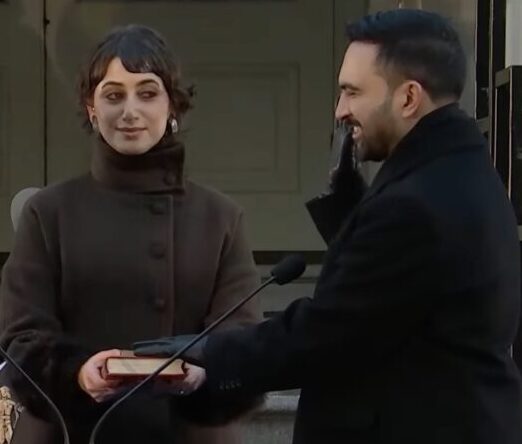
Alright, so here’s the situation—and you can almost hear the record scratch in the background. New York City’s first lady, Rama Duwaji, is suddenly under the microscope, and not for ribbon cuttings or charity galas. No, we’re talking about a trail of old social media posts that read less like youthful awkwardness and more like a greatest hits compilation of anti-American sentiment and eyebrow-raising praise for figures tied to terrorism. And folks, this isn’t ancient history scribbled in a high school diary—this is stuff that was posted online, publicly, for the world to see.
Now, the defense you’re going to hear—and you can set your watch to it—is that these posts were made when she was young. Teenager, early twenties, different time, different place. And sure, people grow, people change. Nobody’s arguing that a dumb tweet at 17 should define your entire life. But here’s where it gets tricky: we’re not talking about cringey selfies or bad poetry. We’re talking about reposts and praise involving individuals tied to the Popular Front for the Liberation of Palestine, which, last time anyone checked, is still designated by the U.S. government as a terrorist organization.
One post features Leila Khaled—yes, the same Leila Khaled who participated in airplane hijackings—paired with a quote about embracing death for a cause. That’s not exactly subtle. That’s not “I was young and figuring things out.” That’s ideological signaling, plain and simple. And when you combine that with other posts praising militants like Shadia Abu Ghazaleh or highlighting imagery from the First Intifada—a period marked by violence and the rise of groups like Hamas—you start to see a pattern that goes beyond casual posting.
And then, just to round things out, there’s the post taking a shot at American soldiers. Not a nuanced critique of foreign policy, mind you, but a sweeping declaration that U.S. troops are “not brave” and are simply enforcing “American hegemony.” That’s the kind of rhetoric you’d expect at a campus protest megaphone session, not from someone now connected to the leadership of the largest city in the country.
Now here’s where the political temperature rises. Because if the roles were reversed—if a conservative figure had a history of posting anything remotely sympathetic to extremist groups or disparaging American troops in that tone—does anyone seriously believe the media would treat it as a minor footnote? You’d have wall-to-wall coverage, panel discussions, and probably a documentary series by the weekend. Instead, what we’re seeing is a more measured, almost cautious approach, as if everyone’s trying to decide just how much this actually matters.
But it does matter, and not because people can’t evolve. It matters because public figures—especially those adjacent to power—don’t get the luxury of having their past completely ignored when it involves explicit political or ideological positions. If you’ve publicly aligned yourself, even indirectly, with individuals or movements tied to violence or anti-American rhetoric, people are going to ask questions. That’s not unfair—that’s accountability.
And let’s talk about timing. These accounts have conveniently gone dark. Gone. Vanished. Which, again, is something we’ve all seen before. The digital cleanup crew comes in, wipes the slate, and hopes nobody took screenshots. Spoiler alert: someone always takes screenshots.
The broader issue here isn’t just about one person’s old posts. It’s about a pattern we’ve seen play out over and over—where certain viewpoints get a pass, get contextualized, get softened, while others are treated like five-alarm fires. And people notice that. Voters notice that. Regular Americans who don’t spend their days parsing academic language about “context” and “lived experience” notice that.
So now the question becomes: does Duwaji address this directly? Does she explain, clarify, maybe even disavow some of this? Or does this get brushed aside as irrelevant history? Because in a city like New York, where symbolism and messaging carry real weight, this isn’t the kind of story that just quietly disappears.
And if you think it will, well, you haven’t been paying attention.